Investing is one of the most effective ways to build long-term wealth, but choosing the right investment strategy can be challenging. Many investors find themselves comparing the Charles Schwab S&P 500 Index Fund with individual stocks to determine which option offers better returns, lower risk, and greater long-term growth potential.
Both investment approaches have their advantages and drawbacks. While individual stocks can provide the opportunity for exceptional gains, index funds offer diversification, simplicity, and lower risk. Understanding the differences between these two investment options can help you make a more informed decision based on your financial goals, risk tolerance, and investment experience.
In this guide, we will compare the Charles Schwab S&P 500 Index Fund and individual stocks in detail to help you decide which investment strategy may be best for you.
What Is the Charles Schwab S&P 500 Index Fund?
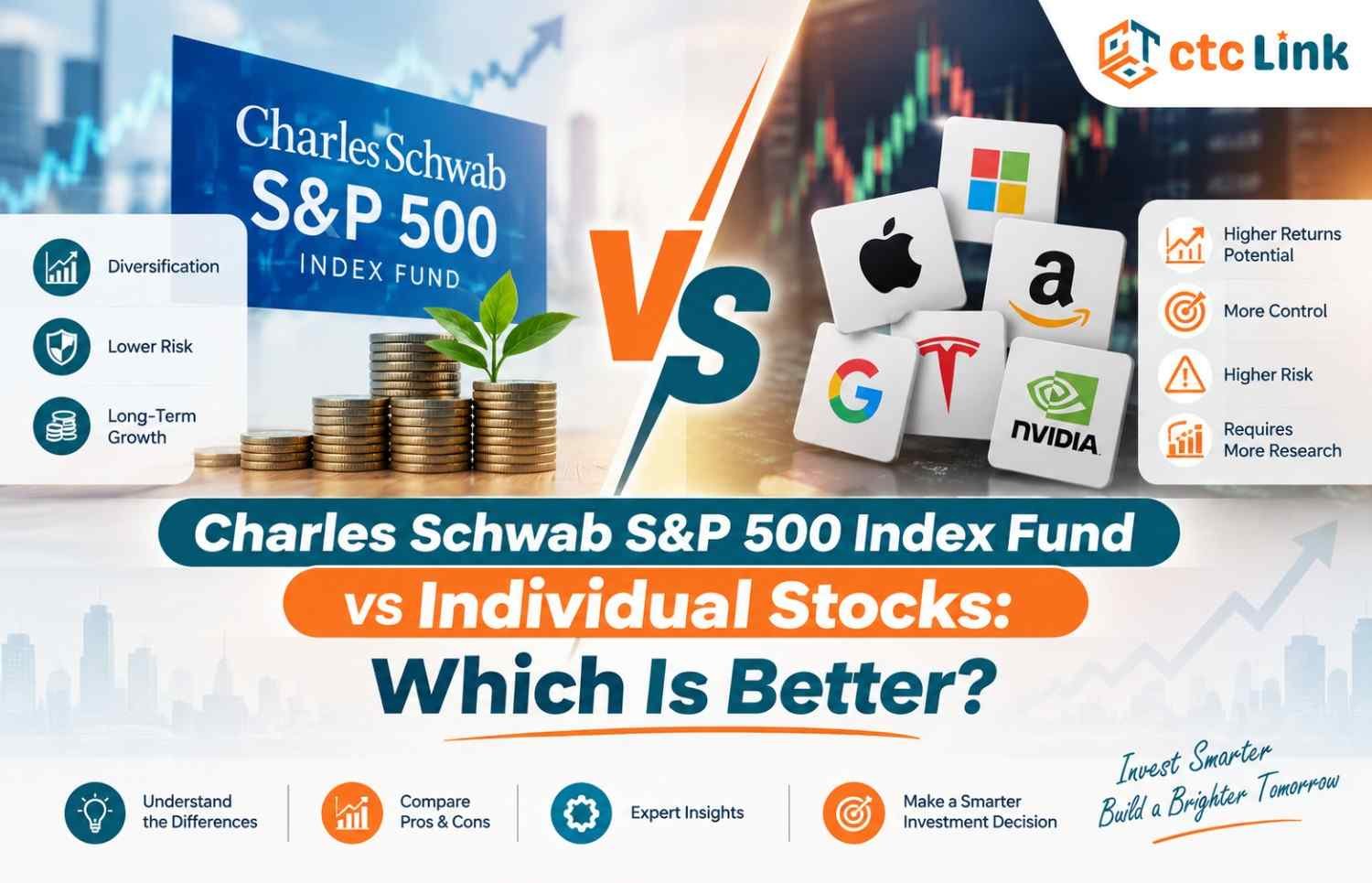
The Charles Schwab S&P 500 Index Fund (SWPPX) is a mutual fund designed to track the performance of the S&P 500 Index, which includes approximately 500 of the largest publicly traded companies in the United States.
Some of the major companies included in the S&P 500 are:
- Apple
- Microsoft
- Amazon
- NVIDIA
- Alphabet (Google)
- Meta Platforms
- Berkshire Hathaway
- Tesla
When you invest in SWPPX, you are essentially purchasing small ownership stakes in hundreds of leading U.S. companies through a single investment.
Key Features
- Broad market diversification
- Low expense ratio
- Professional fund management
- Long-term growth potential
- Easy portfolio management
The goal is not to beat the market but to match the overall performance of the S&P 500.
What Are Individual Stocks?
Individual stocks represent ownership in a single company. When you buy shares of a company like Apple, Amazon, or Tesla, your investment performance depends entirely on that company’s success.
Unlike index funds, individual stocks can significantly outperform or underperform the market.
Benefits of Individual Stocks
- Potential for higher returns
- More control over investment choices
- Ability to invest in specific industries
- Dividend opportunities
Risks of Individual Stocks
- Higher volatility
- Greater risk of loss
- Requires ongoing research
- Company-specific risks
A poor earnings report, management scandal, or industry downturn can cause a stock to lose substantial value.
Charles Schwab S&P 500 Index Fund vs Individual Stocks
Let’s compare these investment options across several important factors.
1. Diversification
Charles Schwab S&P 500 Index Fund
Diversification is one of the strongest advantages of the Schwab S&P 500 Index Fund.
Instead of relying on one company, your money is spread across approximately 500 large U.S. businesses operating in multiple industries.
If one company performs poorly, other companies may offset the losses.
Individual Stocks
When investing in individual stocks, your portfolio may be concentrated in a few companies.
For example, if you invest heavily in one technology stock and it declines sharply, your portfolio can suffer significant losses.
Winner: Charles Schwab S&P 500 Index Fund
Diversification helps reduce risk and improve portfolio stability.
2. Potential Returns
Charles Schwab S&P 500 Index Fund
Historically, the S&P 500 has delivered average annual returns of approximately 10% before inflation over long periods.
While these returns are attractive, they are generally limited to overall market performance.
Individual Stocks
Some stocks have dramatically outperformed the market.
Examples include:
- Apple
- NVIDIA
- Amazon
- Tesla
Investors who identify winning companies early can potentially achieve returns far exceeding those of an index fund.
However, many stocks also underperform or fail entirely.
Winner: Individual Stocks
Individual stocks offer greater upside potential but come with higher risk.
3. Risk Level
Charles Schwab S&P 500 Index Fund
Because it holds hundreds of companies, the fund reduces company-specific risk.
Even during market downturns, diversified funds often recover over time as the economy grows.
Individual Stocks
A single company can experience:
- Declining sales
- Regulatory issues
- Leadership problems
- Competitive pressures
These events can lead to substantial losses.
Winner: Charles Schwab S&P 500 Index Fund
For most investors, index funds provide a safer path to long-term growth.
4. Time Commitment
Charles Schwab S&P 500 Index Fund
Investing in SWPPX requires very little maintenance.
Investors can:
- Make regular contributions
- Reinvest dividends
- Hold for decades
There is minimal need for constant monitoring.
Individual Stocks
Stock investing requires:
- Company research
- Earnings analysis
- Market monitoring
- Portfolio adjustments
Successful stock selection demands time and effort.
Winner: Charles Schwab S&P 500 Index Fund
It is ideal for busy investors seeking a hands-off strategy.
5. Costs and Fees
Charles Schwab S&P 500 Index Fund
SWPPX is known for its low expense ratio.
Low fees help investors keep more of their investment returns over time.
Individual Stocks
Although many brokers offer commission-free trading, investors may face indirect costs such as:
- Research tools
- Trading mistakes
- Tax inefficiencies
Frequent trading can also reduce long-term returns.
Winner: Charles Schwab S&P 500 Index Fund
Low-cost investing is one of the biggest reasons index funds have become so popular.
6. Emotional Investing
Charles Schwab S&P 500 Index Fund
Index fund investors typically focus on long-term growth rather than short-term market fluctuations.
This encourages disciplined investing behavior.
Individual Stocks
Individual stock investors often react emotionally to:
- Market news
- Earnings reports
- Price swings
Emotional decisions can lead to buying high and selling low.
Winner: Charles Schwab S&P 500 Index Fund
A passive strategy helps reduce emotional investing mistakes.
7. Income Through Dividends
Charles Schwab S&P 500 Index Fund
Many S&P 500 companies pay dividends.
The fund collects these dividends and distributes them to shareholders.
Individual Stocks
Investors can specifically target high-dividend companies for income generation.
Examples include utility, healthcare, and consumer staple companies.
Winner: Tie
Both options can generate dividend income depending on your investment goals.
Who Should Choose the Charles Schwab S&P 500 Index Fund?
The Schwab S&P 500 Index Fund may be the better choice if you:
- Are a beginner investor
- Prefer a low-maintenance portfolio
- Want broad diversification
- Have a long-term investment horizon
- Want lower investment risk
- Are saving for retirement
Many financial experts recommend index funds as the foundation of a long-term investment strategy.
Who Should Choose Individual Stocks?
Individual stocks may be suitable if you:
- Enjoy researching companies
- Have investing experience
- Can tolerate higher risk
- Seek potentially higher returns
- Want greater control over investments
Investors who understand business fundamentals and market trends may benefit from allocating a portion of their portfolio to individual stocks.
Can You Invest in Both?
Absolutely.
Many successful investors combine both strategies.
A common approach is:
- 70%–90% in a diversified index fund like the Charles Schwab S&P 500 Index Fund
- 10%–30% in carefully selected individual stocks
This strategy provides the stability of index investing while allowing opportunities for higher returns through stock selection.
For example, an investor might hold SWPPX as their core investment while adding shares of promising companies in technology, healthcare, or artificial intelligence sectors.
Final Verdict: Which Is Better?
The answer depends on your financial goals and investing style.
If your priority is simplicity, diversification, lower risk, and long-term wealth building, the Charles Schwab S&P 500 Index Fund is generally the better option for most investors.
However, if you have the knowledge, time, and risk tolerance to research companies and manage your portfolio actively, individual stocks can potentially deliver higher returns.
For many investors, the smartest strategy is not choosing one over the other but combining both. Using the Charles Schwab S&P 500 Index Fund as a solid foundation while selectively investing in individual stocks can create a balanced portfolio that offers both stability and growth potential.
As always, consider your investment objectives, time horizon, and risk tolerance before making any investment decisions. Building wealth is less about finding the perfect investment and more about staying invested consistently over the long term.
About the Author