Mutual funds have become one of the most popular investment options for individuals looking to grow their wealth without directly managing stocks, bonds, or other securities. Whether you’re a beginner investor or someone looking to diversify your portfolio, understanding the different types of mutual funds is essential for making informed financial decisions.
With hundreds of mutual fund schemes available in the market, choosing the right one can feel overwhelming. Some funds focus on high growth, while others prioritize stability and regular income. Each category is designed to meet specific investment goals, risk levels, and time horizons.
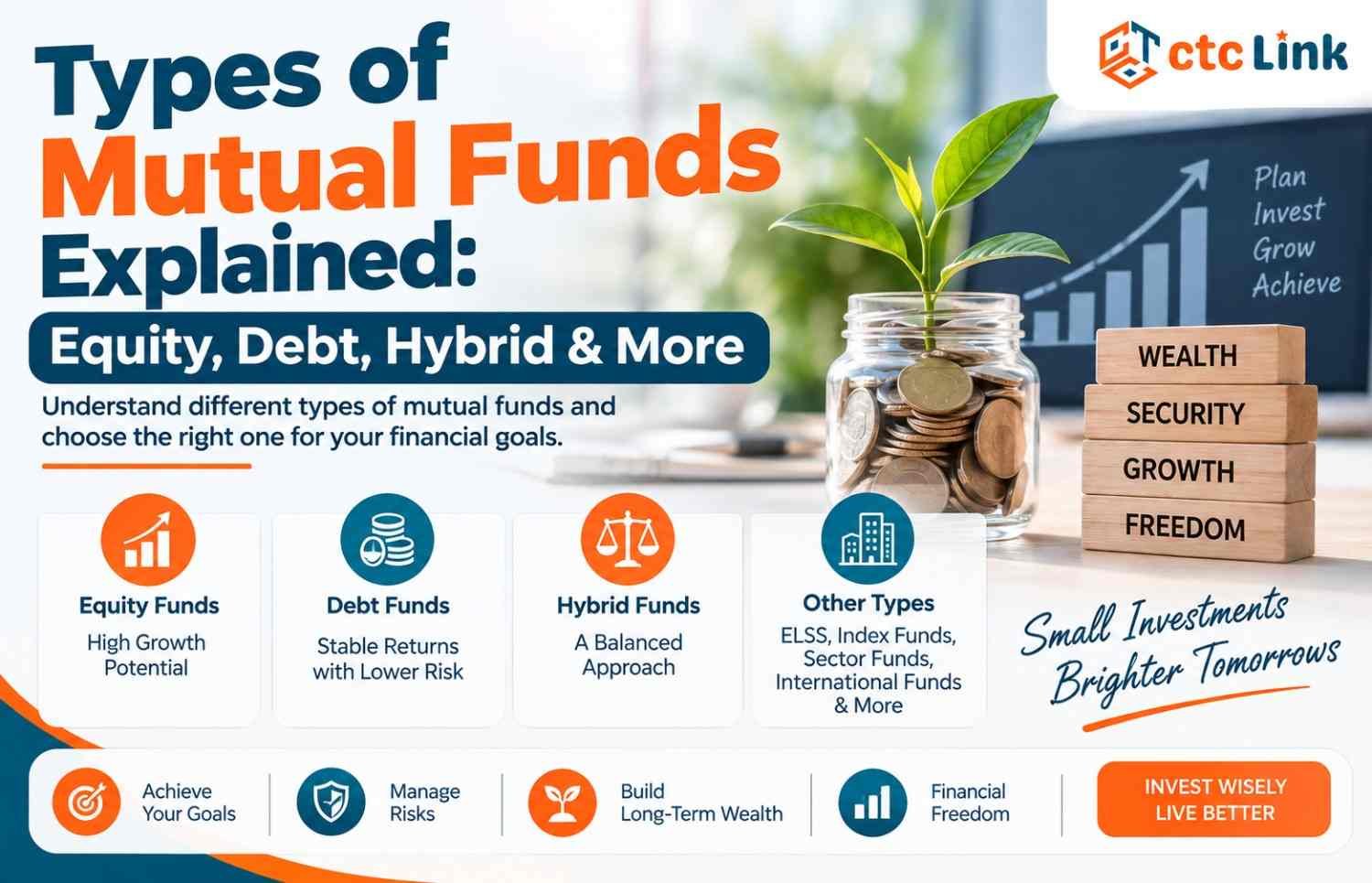
In this guide, we’ll explain the major types of mutual funds, including equity funds, debt funds, hybrid funds, index funds, sector funds, and more, helping you understand which option may be suitable for your financial objectives.
What Is a Mutual Fund?
A mutual fund is a professionally managed investment vehicle that pools money from multiple investors and invests it in a diversified portfolio of assets such as stocks, bonds, money market instruments, or a combination of these.
Professional fund managers make investment decisions on behalf of investors, aiming to achieve the fund’s stated objectives.
Benefits of Mutual Funds
- Professional management
- Diversification
- Affordable investment options
- Liquidity
- Flexibility through SIPs (Systematic Investment Plans)
- Suitable for both beginners and experienced investors
Before investing, it is important to understand the different categories of mutual funds and how they work.
1. Equity Mutual Funds
Equity mutual funds primarily invest in stocks of publicly listed companies. These funds are designed to generate long-term capital appreciation.
Since stock markets can be volatile, equity funds are generally considered high-risk investments. However, they also offer the potential for higher returns compared to many other investment options.
Types of Equity Funds
Large-Cap Funds
These funds invest in established companies with large market capitalizations.
Examples include investments in companies such as:
- Reliance Industries
- TCS
- Infosys
- HDFC Bank
Risk Level: Moderate
Suitable For: Long-term investors seeking stable growth.
Mid-Cap Funds
Mid-cap funds invest in medium-sized companies with strong growth potential.
Risk Level: High
Suitable For: Investors willing to accept higher volatility for potentially higher returns.
Small-Cap Funds
These funds focus on smaller companies that may experience rapid growth.
Risk Level: Very High
Suitable For: Aggressive investors with a long investment horizon.
Multi-Cap and Flexi-Cap Funds
These funds invest across large-cap, mid-cap, and small-cap stocks, offering greater diversification.
Risk Level: Moderate to High
2. Debt Mutual Funds
Debt funds primarily invest in fixed-income securities such as government bonds, treasury bills, corporate bonds, and other debt instruments.
These funds aim to provide stable returns while preserving capital.
Debt funds are generally less volatile than equity funds and are often chosen by conservative investors.
Types of Debt Funds
Liquid Funds
Liquid funds invest in short-term debt instruments with very short maturities.
Risk Level: Low
Suitable For: Parking emergency funds or surplus cash.
Short-Term Debt Funds
These funds invest in bonds with shorter maturities.
Risk Level: Low to Moderate
Suitable For: Investors seeking predictable returns.
Corporate Bond Funds
Corporate bond funds invest primarily in high-rated corporate debt securities.
Risk Level: Moderate
Suitable For: Investors seeking higher yields than traditional savings products.
Gilt Funds
Gilt funds invest exclusively in government securities.
Risk Level: Moderate
Suitable For: Investors seeking government-backed investments.
3. Hybrid Mutual Funds
Hybrid funds combine investments in both equity and debt instruments.
The objective is to balance growth potential with risk management.
These funds are ideal for investors who want exposure to stock markets while maintaining some stability through fixed-income investments.
Types of Hybrid Funds
Aggressive Hybrid Funds
Typically allocate a larger portion to equities and a smaller portion to debt.
Risk Level: Moderate to High
Conservative Hybrid Funds
Invest more heavily in debt instruments and less in equities.
Risk Level: Low to Moderate
Balanced Advantage Funds
These funds dynamically adjust equity and debt allocations based on market conditions.
Risk Level: Moderate
Multi-Asset Funds
Invest across multiple asset classes such as:
- Equity
- Debt
- Gold
- International securities
Risk Level: Moderate
Also Read: Charles Schwab S&P 500 Index Fund vs Individual Stocks: Which Is Better?
4. Index Funds
Index funds are passive mutual funds that track a specific market index.
Rather than attempting to outperform the market, they aim to replicate the performance of a chosen benchmark.
Popular indexes include:
- Nifty 50
- Sensex
- S&P 500
- Nasdaq 100
Advantages of Index Funds
- Low expense ratios
- Broad diversification
- Simple investment strategy
- Consistent long-term performance
Many financial experts recommend index funds for long-term wealth creation due to their simplicity and cost efficiency.
5. ELSS Funds (Equity Linked Savings Schemes)
ELSS funds are tax-saving mutual funds that primarily invest in equities.
These funds offer tax benefits under applicable tax regulations and have a mandatory lock-in period.
Key Features
- Potential for high returns
- Tax-saving benefits
- Equity market exposure
- Shorter lock-in compared to many traditional tax-saving instruments
Risk Level: Moderate to High
Suitable For: Investors seeking both tax benefits and long-term growth.
6. Sectoral and Thematic Funds
Sectoral and thematic funds focus on specific industries or investment themes.
Examples include:
Sector Funds
- Technology Funds
- Banking Funds
- Healthcare Funds
- Infrastructure Funds
Thematic Funds
- Artificial Intelligence Funds
- ESG Funds
- Consumption Funds
- Digital Economy Funds
Because these funds concentrate investments in specific sectors, they carry higher risk.
Risk Level: High
Suitable For: Experienced investors with strong market knowledge.
7. International Mutual Funds
International mutual funds invest in companies and markets outside the investor’s home country.
These funds provide global diversification and exposure to international growth opportunities.
Examples include investments in:
- U.S. stocks
- European companies
- Asian markets
- Global technology firms
Benefits
- Geographic diversification
- Access to global industries
- Reduced dependence on domestic markets
Risk Level: Moderate to High
8. Solution-Oriented Mutual Funds
These funds are designed to help investors achieve specific financial goals.
Retirement Funds
Focused on long-term retirement planning.
Children’s Funds
Created to support future educational or financial needs of children.
These funds often have lock-in periods to encourage disciplined investing.
Risk Level: Varies based on fund strategy.
How to Choose the Right Mutual Fund
Selecting the right mutual fund depends on several factors.
Consider Your Financial Goals
Ask yourself:
- Are you investing for retirement?
- Do you want regular income?
- Are you seeking long-term wealth creation?
- Are you saving for a major purchase?
Your objective should guide your investment choice.
Assess Your Risk Tolerance
Different mutual funds carry different levels of risk.
Conservative Investors
May prefer:
- Debt Funds
- Liquid Funds
- Conservative Hybrid Funds
Moderate Investors
May consider:
- Balanced Advantage Funds
- Hybrid Funds
- Large-Cap Equity Funds
Aggressive Investors
May choose:
- Small-Cap Funds
- Sector Funds
- Thematic Funds
Evaluate Investment Horizon
- Short-term goals: Debt Funds or Liquid Funds
- Medium-term goals: Hybrid Funds
- Long-term goals: Equity Funds and Index Funds
Matching your investment horizon with the appropriate fund category can improve outcomes.
Common Mistakes to Avoid
When investing in mutual funds, avoid these common mistakes:
- Investing without clear goals
- Chasing past performance
- Ignoring expense ratios
- Not diversifying investments
- Reacting emotionally to market fluctuations
- Frequently switching between funds
Successful investing often requires patience and a long-term perspective.
Conclusion
Mutual funds offer a versatile and accessible way to build wealth while benefiting from professional portfolio management. From equity funds that focus on growth to debt funds designed for stability and hybrid funds that balance both, there is a mutual fund category for nearly every investor.
Understanding the various **types of mutual funds—Equity, Debt, Hybrid, Index, ELSS, Sectoral, International, and Solution-Oriented Funds—**can help you align your investments with your financial goals and risk tolerance.
For beginners, diversified options such as index funds and hybrid funds often provide a strong starting point. More experienced investors may explore sectoral or thematic funds to capitalize on specific market opportunities.
The key to successful mutual fund investing is selecting the right fund, staying invested consistently, and maintaining a long-term focus. By doing so, you can take advantage of compounding and work steadily toward achieving your financial goals.
About the Author